What Does Being a Freemason Really Mean?
Freemasonry. The word itself conjures a cascade of images, from secret handshakes in smoke filled rooms to grand conspiracies shaping the course of history. It whispers of ancient rites, profound symbols, and a brotherhood of powerful men. But beneath the layers of myth, mystery, and Hollywood fiction, what is the genuine Freemason meaning? What does it truly mean to be a member of this ancient and honorable fraternity? This is not a simple question, but its answer reveals a rich and compelling world dedicated to a simple, yet profound, purpose, making good men better.
We will peel back the veil of speculation. Together, we will explore the core principles, the intricate symbolism, and the transformative journey that defines the Masonic experience. Forget what you think you know. Prepare to discover the authentic meaning of Freemasonry, a system of morality veiled in allegory and illustrated by symbols, designed for the modern man seeking a deeper connection to himself, his community, and the timeless virtues that bind humanity together.
What is Freemasonry at its Core?
At its heart, Freemasonry is the world’s oldest and largest fraternity, a voluntary association of men bound by a shared commitment to self improvement and service to humanity. It is a structured system of moral philosophy that uses the tools and allegories of ancient stonemasons to teach its members about ethics, relationships, and the search for truth. It is not a religion or a political organization, but a brotherhood that transcends all social, ethnic, and religious divisions.
Freemasonry provides a unique space for men to meet on a level playing field. Inside the Masonic lodge, a man’s wealth, status, or profession holds no weight. He is judged only by his character and his commitment to the fraternity’s core tenets of Brotherly Love, Relief, and Truth.

Is Freemasonry a Religion?
No, Freemasonry is not a religion, and it does not seek to replace a man’s personal faith. It is, however, a spiritual pursuit in the sense that it requires every member to profess a belief in a Supreme Being, often referred to within the lodge as the Great Architect of the Universe. This non-denominational approach allows men of different faiths, be they Christian, Jewish, Muslim, or any other creed, to unite in fellowship without compromising their individual religious beliefs.
The fraternity provides a framework for moral and ethical living that complements, rather than competes with, a member’s religion. It encourages each Mason to be steadfast in the faith of his own choosing. The lodge is a place for moral instruction, not theological doctrine.

Is Freemasonry a Secret Society?
No, Freemasonry is more accurately described as a society with secrets, not a secret society. A truly secret society is one whose very existence is unknown to the public. Freemasonry, by contrast, is openly acknowledged, with Masonic lodges clearly marked in towns and cities across the globe, and its members are often proud to identify themselves.
The "secrets" of Freemasonry pertain to its traditional modes of recognition, such as specific handshakes and passwords, and the symbolic details of its private degree ceremonies. These traditions serve to guard the rituals from those who are not prepared to understand their meaning and to ensure that any man claiming to be a Mason can prove it to his Brothers. The moral and philosophical teachings of the Craft, however, are widely available and discussed in countless books and public resources.

What are the Basic Principles of Freemasonry?
The foundational principles of Freemasonry are summarized in three great tenets, Brotherly Love, Relief, and Truth. These are not merely abstract ideals, they are active virtues that every Mason is charged to practice in his daily life.
Brotherly Love is the practice of tolerance, respect, and kindness toward all people. It means seeing the best in others and caring for the needs of our fellow man, particularly a Brother Mason. It is the glue that binds the fraternity together, creating a powerful network of mutual support that extends across the world.

Relief, which today we would call charity, is a tangible expression of Brotherly Love. It encompasses a wide range of philanthropic efforts, from assisting a Brother’s family in times of hardship to supporting vast charitable enterprises like hospitals, children’s homes, and scholarship funds that benefit the public at large.
Truth is the ultimate object of a Mason’s pursuit. It represents the search for knowledge, both intellectual and spiritual. Freemasonry encourages its members to be men of integrity, to seek wisdom, and to live with honor and virtue, guided by a well-informed conscience and a devotion to what is right.

What is the Meaning Behind Masonic Symbols?
Masonic symbols are the visual language of the Craft, a rich tapestry of allegorical images designed to teach complex moral and philosophical lessons without spoken words. Freemasonry uses symbolism because it allows a single image to convey multiple layers of meaning, speaking directly to a man’s intellect and conscience. These symbols are not objects of worship, they are tools for contemplation and self-reflection.
The use of symbols drawn from geometry and architecture is a legacy of the operative stonemason guilds from which Freemasonry evolved. Just as an ancient builder used his tools to erect a perfect physical structure, a modern Freemason uses the symbolic meaning of those same tools to build a more upright and virtuous character within himself.

What Does the Square and Compasses Symbolize?
The Square and Compasses is the most universally recognized symbol of Freemasonry, representing the core of Masonic philosophy. It symbolizes the lifelong process of moral and spiritual development, reminding a Mason to square his actions by the square of virtue and to circumscribe his desires and passions within due bounds.
The square is an emblem of morality and fairness, teaching a Mason to be "on the square" in all his dealings. The compasses represent the importance of self-control and restraint, defining the limits of one’s conduct. Often, the letter ‘G’ is found in the center, which stands for Geometry, the basis of the stonemason’s art, and for God, the Great Architect of the Universe, who should be at the center of a Mason’s life.

What is the Significance of the All Seeing Eye?
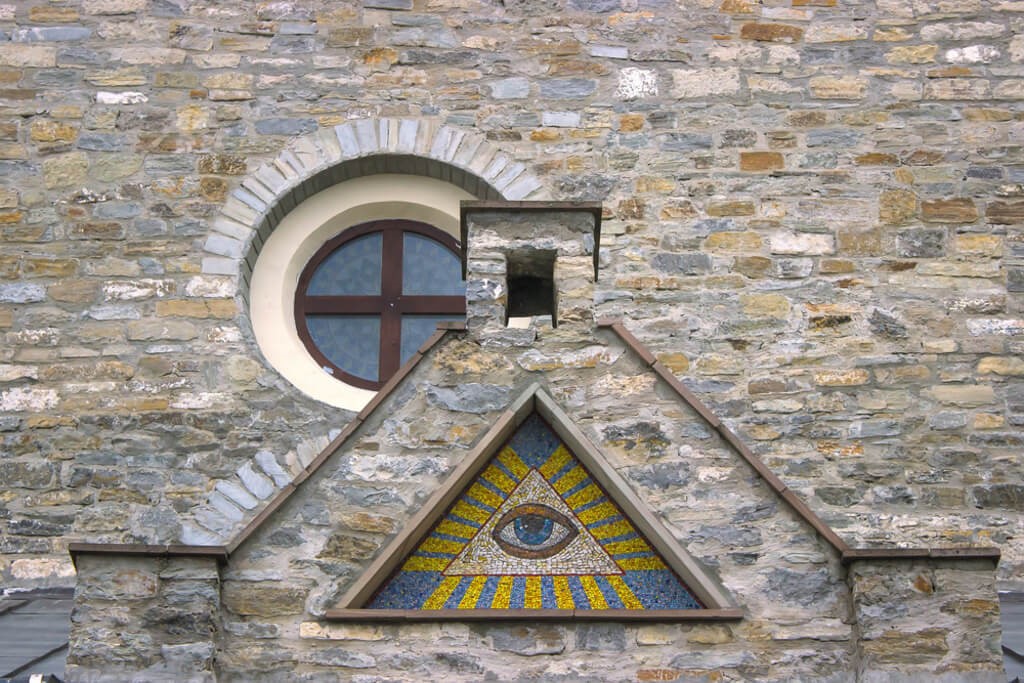
The All Seeing Eye, or Eye of Providence, represents the constant, watchful care of the Supreme Being. It is a powerful reminder to every Freemason that his thoughts, words, and actions are always observed by his Creator, even when no human eye can see. This symbol encourages a life of integrity, as a man who believes he is always in the presence of God will be more inclined to act with honor and rectitude.
Contrary to popular conspiracy theories, this symbol is not uniquely Masonic and has been used by various cultures and religions for thousands of years, including in Christian art, to represent divine omniscience. In Freemasonry, it serves as a personal, contemplative symbol, not an emblem of control or surveillance over society.